
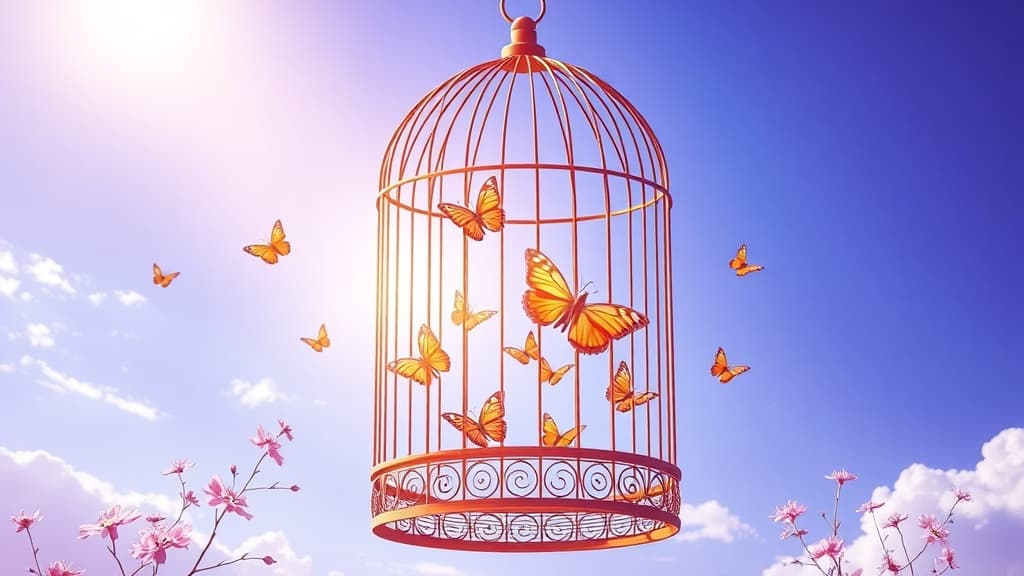
8 Keys to Learning How to Let Go in Daily Life
In our hyperconnected society, we're constantly overwhelmed, pulled between countless responsibilities and worries. Control has become our drug, and anxiety our constant companion. Yet, how to let go in daily life isn't just about well-being: it's a vital necessity for reclaiming our inner freedom.
Letting go doesn't mean giving up or becoming passive. It's about consciously choosing where to place our precious energy. It's understanding that we don't control everything, but we can always choose our response to events.
Today, more than ever, this skill becomes essential. AI is transforming our relationship with work, collective anxiety overwhelms us through media, and we must relearn how to be rather than constantly do.
Here are 8 practical keys to transform your daily life and rediscover that lightness that belongs to you.
1. Breathe Consciously to Create Inner Space
Conscious breathing is your first tool for understanding how to let go in daily life. When we're stressed, our breathing becomes short and shallow, creating a vicious cycle of tension.
The 4-7-8 technique: Inhale through your nose counting to 4, hold your breath counting to 7, exhale through your mouth counting to 8. Repeat at least 3 times.
This simple practice activates your parasympathetic nervous system—the relaxation response. In seconds, you create space between yourself and your worries.
Real example: Before opening your email in the morning, take 30 seconds to breathe consciously. You'll approach your inbox with more serenity and discernment. Instead of reacting impulsively to every notification, you'll consciously choose your priorities.
This practice literally transforms your neurochemistry. Your brain produces less cortisol (stress hormone) and more serotonin (well-being hormone). You're no longer a victim of your automatic reactions.
2. Accept Imperfection as a Path to Freedom
Perfectionism is one of the biggest obstacles to how to let go in daily life. We exhaust ourselves trying to control everything, optimize everything, succeed perfectly at everything.
Accepting imperfection isn't resignation—it's wisdom. It's understanding that perfection is an illusion that keeps us trapped in a golden prison of constant stress.
The 80/20 rule: Focus on the 20% of effort that produces 80% of results. The rest can be "good enough." This approach frees up considerable energy for what truly matters.
Real example: Instead of spending 2 hours perfecting a work email, write it in 20 minutes with authenticity and kindness. Your colleagues will appreciate your humanity more than your technical perfection.
When you accept imperfection, you give yourself permission to be human. You stop judging yourself constantly and rediscover that natural lightness that is your authentic state of being. Imperfection then becomes a doorway to more authenticity and genuine connection with others.
3. Practice Active Gratitude to Transform Your Perspective
Gratitude isn't an abstract spiritual concept—it's a powerful neurological tool for reprogramming your brain. When we focus on what's missing, we create a state of permanent tension. Active gratitude reverses this dynamic.
How to let go in daily life necessarily involves this transformation of perspective. Instead of seeing what's wrong, we consciously choose to see what's already working.
The 3 daily gratitudes technique: Each evening, write down 3 things you're grateful for, specifying why. Not just "my family," but "my child's smile this morning that reminded me of the simple beauty of the present moment."
Real example: In a traffic jam, instead of complaining, find 3 elements of gratitude: this forced pause, the music you're listening to, having a car at all. Your stress level drops immediately.
This practice literally rewires your brain. After a few weeks, you'll naturally notice more positive aspects in your daily life. Your energy rises, and solutions appear more easily.
4. Define Your Spheres of Influence to Conserve Your Energy
One of the fundamental keys for how to let go in daily life is clearly distinguishing what you can control from what you cannot control.
We waste tremendous energy worrying about things completely beyond our control: the weather, other people's decisions, the global economy, traffic jams...
The circles exercise: Draw three concentric circles. The inner circle = what you control completely (your thoughts, actions, reactions). The middle circle = what you can influence (close relationships, immediate environment). The outer circle = what completely escapes you.
Real example: Your teenager comes home late without warning. You don't control their choices (outer circle), but you can influence the relationship through communication (middle circle) and you completely control your reaction: destructive anger or constructive dialogue (inner circle).
By concentrating your energy only on your inner circles, you become infinitely more effective and serene. You stop exhausting yourself in battles that are lost from the start.
5. Transform Your Expectations into Light Preferences
Rigid expectations are major sources of suffering. We create precise mental scenarios of "how things should go," then frustrate ourselves when reality doesn't match.
How to let go in daily life involves transforming these heavy expectations into light preferences. Instead of "It MUST...", adopt "It would be nice if..."
This nuance changes everything. Preferences leave us open to life's surprises, while expectations lock us into rigid patterns.
The "Mental Plan B" technique: For each important situation, imagine 2-3 possible scenarios. This mentally prepares you for the unexpected and reduces attachment to a single outcome.
Real example: You're organizing a picnic. Instead of desperately expecting sunshine, mentally prepare alternatives: covered picnic, cozy indoor activity, or postponement to another day. Whatever happens, you stay in joy rather than frustration.
This mental flexibility makes you infinitely more resilient and open to the unexpected opportunities life constantly offers you.
6. Cultivate the Art of Saying No with Kindness
Knowing how to say no is essential for how to let go in daily life. We often overload ourselves from fear of disappointing, missing opportunities, or from the habit of "automatic yes."
Saying no means saying yes to what truly matters to you. It's an act of self-love and, paradoxically, love for others too.
The "No sandwich" technique:
- Thank them for the proposal
- Clearly express your no with a simple reason
- Offer an alternative or express your goodwill
Real example: "Thank you for thinking of me for this project. I can't commit right now because I already have several priorities in progress. I warmly recommend [person's name] who would be perfect for this."
When you say no to good things, you free up space for excellent things. Your energy becomes more concentrated, more powerful. You stop scattering yourself and reclaim your creative power.
Kindly saying no preserves relationships while protecting your precious energy.
7. Practice Emotional Detachment from Collective Energies
Collective energies are those group influences that affect us without our awareness: ambient anxiety, social media anger, collective workplace stress...
Understanding how to let go in daily life requires recognizing these influences and consciously protecting yourself from them.
The energy shield technique: Visualize yourself surrounded by a bubble of white light that filters external energies. Only positive energies can enter; negative ones bounce off without affecting you.
The 24-hour rule: Before sharing a strong emotion (anger, indignation, fear), wait 24 hours. Often, this emotion doesn't even belong to you—it's part of a temporary collective energy.
Real example: In a tense meeting where collective energy is negative, instead of absorbing this tension, breathe consciously and anchor yourself in your own centering. You can even secretly send kindness to the group. Your stable energy positively influences the group.
This practice frees you from external emotional fluctuations. You regain mastery over your inner state.
8. Embrace the Present Moment as Your Only Reality
The past no longer exists, the future doesn't exist yet. Only the present moment is real. Yet we spend 90% of our mental time elsewhere: past regrets, future anxieties.
How to let go in daily life reaches its peak in this ability to fully inhabit the present moment. This is where life truly unfolds.
The 5 senses technique: Regularly throughout the day, connect with your 5 senses:
- What do I see?
- What do I hear?
- What do I smell?
- What do I taste?
- What do I touch?
Real example: While drinking your morning coffee, instead of checking your phone, savor consciously: the warmth of the cup in your hands, the rising aroma, the taste in your mouth, the sensations in your body. These few minutes of conscious attention transform an automatic gesture into a moment of fullness.
The present moment is your permanent refuge. As soon as you anchor yourself there, mental problems naturally fade. You rediscover that peace which is your deep nature.
Bonus: Laugh at Yourself, the Ultimate Superpower
Here's the secret few people understand: humor is the most powerful tool for letting go. When you laugh at your own quirks, your little obsessions, your daily dramas, you instantly create distance and lightness.
The ego takes everything seriously. The soul knows how to laugh at everything, even its own difficulties. A shared burst of laughter dissolves more tension than an hour of serious discussion.
The amused observer technique: Step back from your own reactions and look at yourself like a comedy character. "Look, here I go again with my anxious perfectionist routine! What a performance today!"
Real example: You just got annoyed at an object that won't work. Instead of staying frustrated, laugh at this absurd situation: an intelligent adult arguing with a toaster! This self-mockery instantly transforms the energy.
Laughter releases endorphins, relaxes muscles, oxygenates the brain, and raises your vibration. It's an instant emotional reset.
When you can laugh at yourself, nothing can truly affect you long-term. You become unbreakable in your joy.
Your New Freedom Starts Now
How to let go in daily life isn't a destination—it's a journey. Each time you apply one of these 8 keys, you reclaim a bit more of your personal power.
You're no longer a victim of circumstances; you become a conscious creator of your experience. This transformation doesn't require years of practice—it can begin with your next conscious breath.
Your challenge for the next 7 days: Choose just ONE of these techniques and apply it daily. Observe the changes, even subtle ones, in your stress level and quality of presence.
Happiness isn't a future reward—it's a decision you make now. At every moment, you choose: resistance or acceptance, control or letting go, stress or serenity.
If this article resonates with you and you want to go further in this conscious liberation, discover the Humans.team community. Together, we explore these paths of inner freedom and authentic happiness.
Happiness is now ◯